Schools require emergency allergy medicine, but doctors balk
Credit: Bioridge Pharma
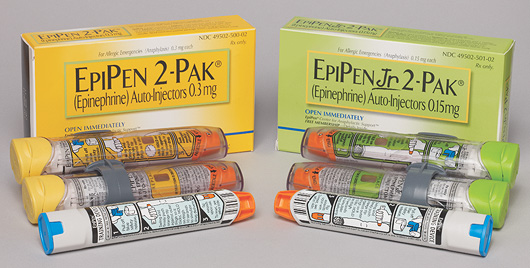
Epi-Pen epinephrine auto-injectors in adult and junior sizes.
 Credit: Bioridge Pharma
Epi-Pen epinephrine auto-injectors in developed and inferior sizes.
When a Murietta Valley Unified School District unproblematic educatee bit into a cupcake made with peanut butter in April, she quickly struggled to exhale. A school health aide grabbed a pre-loaded syringe of adrenaline from the supply cabinet, injected the daughter and contained her allergic reaction until she got to the emergency room, exactly equally a new California law intended – but non, in fact, how the law is playing out in many districts.
Half-dozen months after the Jan. 1 law required schools to stock these pre-loaded syringes – known every bit epinephrine automatic injectors and considered the start line of treatment for potentially life-threatening allergic reactions – many districts have been unable to obtain what Murietta Unified has: a physician's prescription for the devices.
Up and downwardly the state, doctors have declined to write prescriptions for epinephrine machine-injectors for districts, citing liability concerns and derailing the promise of the law. A February survey of 408 school nurses past the California Schoolhouse Nurses Organization found that 57 percent had been unable to obtain epinephrine automobile-injectors for their commune, calling the inability to find a md to write a prescription a major obstruction.
"The police indemnified everybody except the physician," said Dr. Brett Curtis, a consulting doc for the Oakland Unified School District.
Many districts have turned to urban center and county public wellness doctors as the logical prescription writers, only to exist rebuffed. "They are being asked to sign these orders, but are being told past their canton counsel and their risk managers that the liability risks are real," said Kat DeBurgh, executive manager of the Wellness Officers Association of California, a Sacramento-based membership grouping for city and canton public health doctors.
The impasse has prompted the author of the constabulary, state Sen. Robert Huff, R-Diamond Bar, to introduce follow-upwards legislation designed to protect physicians from prosecution if they write these prescriptions. The nib, Senate Nib 738, passed the Senate this calendar month and is in the Assembly.
Dr. Brett Curtis, a consulting physician for the Oakland Unified School District, is all for it. "The standard is to prescribe on the ground of a good-faith exam," he said. Only the law asks doctors to write a prescription naming the school district equally the patient, with the injectors to be used to treat a pupil or adult every bit needed – which means "a patient I've never seen," Curtis said.
"The law indemnified everybody except the physician," he said.
His medical liability insurance company agreed. In lodge to write a prescription to bring Oakland Unified into compliance with the new law, Curtis took out boosted liability insurance. At present he writes prescriptions for stock epinephrine auto-injectors for all 86 schools in Oakland.
About 8 pct of children nationwide have nutrient allergies, according to a 2022 commodity in the journal Pediatrics, and of those, virtually twoscore percentage have had a severe reaction known as anaphylaxis, where blood pressure drops and airways constrict. Other symptoms include hives, a bloated tongue and vomiting.
Astringent food allergies have become an issue in schools across the state and the nation as the pct of children who are allergic to nuts, milk, wheat and other substances has increased, according to the Centers for Disease Command and Prevention, for reasons researchers can't definitively explain.
Some schools take introduced nut-free zones in school cafeterias and ingredient inspections for classroom birthday treats. But enforcement can be difficult.
For instance, but days before the Murietta Valley student took a seize with teeth of the peanut butter-filled cupcake, Cathy Owens, a school nurse and coordinator of student support for the district, sent a memo to teachers stating that parents must give advance permission for their child to eat food brought in for school events. Only at the classroom cupcake political party, that notification never happened, Owens said.
The result is a lot of anxiety for parents and for school nurses like Martha Wallis, who said she has given at least iv emergency epinephrine injections in the past five years in the unified districts of Moreno Valley and Lake Elsinore. A local dr. was willing to write a prescription for stock epinephrine even earlier the police force required schools to have information technology, she said.
I injection was for a high school boy who had a serious reaction to a bee sting, although he didn't know he was allergic to bee venom. Some other was for a kindergarten girl with a known allergy to peanut butter who didn't recognize the circle-shaped peanut butter sandwich in the cafeteria as a peanut butter sandwich – Wallis used the daughter's ain EpiPen, a make of injector, to give her a shot of epinephrine.
A third example involved a 4th-grade boy who couldn't stop vomiting after eating peanut M & Ms final autumn, although he had no known allergy to peanuts. And a fourth instance concerned a teacher who ate mango flavored yogurt and experienced the swollen tongue and constricted throat of a serious allergic reaction, Wallis said.
While many students with severe allergies acquit their own epinephrine car-injectors or go along 1 at the school office, others don't. And twenty percent of severe allergic reactions at schoolhouse happen to children who take never been diagnosed with a severe allergy, said Dr. Marc Lerner, medical officer for the Orange County Department of Teaching.
Equally a school district employee, Lerner says he is covered by the commune's risk insurance. And so he'due south written prescriptions for epinephrine auto-injectors for 600 schools in 28 districts in Orange County, using the website EpiPen4Schools.com, which offers free and reduced-toll epinephrine auto-injectors to schools across the country.
Lerner is one of a group of doctors who have stepped up to write prescriptions for districts. Others are Dr. Timothy Mackey of Riverside, who prescribes for Murietta Valley Unified, Dr. Howard Taras in San Diego and Dr. Travis Miller in Sacramento.
Miller, a board member of the California Society of Allergy, Asthma and Immunology, testified in favor of both the current law and the follow-up legislation and said 10 members of the allergist group expressed concern to him well-nigh liability. But epinephrine is non considered a particularly dangerous medication – it is adrenaline, and receiving a shot unnecessarily volition cause a rapid heartbeat, but has never been reported to crusade death, he said.
So he prescribes for Rocklin Unified School District, Auburn Wedlock School District and others. "I'd rather sit on the right side of wellness care," he said.
At a hearing of the state Senate Judiciary Committee before this month, school nurse Melissa Locketz urged passage of the new legislation to dispatch physicians' liability worries. She read five statements from beau school nurses, including this one: "It does not seem fair that some schools are lucky to accept relationships with physicians, while others tin can't comply because no one volition sign."
To get more reports similar this one, click hither to sign upward for EdSource's no-cost daily e-mail on latest developments in education.
Source: https://edsource.org/2015/schools-require-emergency-allergy-medicine-but-doctors-balk/80214

Post a Comment for "Schools require emergency allergy medicine, but doctors balk"