Not Encounter Again in the Future
ten grand challenges we'll face by 2050

Editing genes, ageing populations, rising body of water levels… the world is moving faster than e'er. What will those trends mean for our guild over the side by side 30 years?
Grand Challenges
In this special serial, Hereafter Now takes a close look at the biggest, most important issues we face in the 21st Century.
For two months, we'll bring you lot insight from leading scientists, technologists, entrepreneurs and influencers to assistance you make sense of the challenges nosotros face in today'southward apace evolving world.
Over the terminal few months, BBC Future Now has been examining some of the biggest problems humankind faces right now: country use to conform exploding populations, the future of nuclear energy, the chasm betwixt rich and poor – and much more.
But what about the big challenges that are brewing for the time to come? In xxx years, what might be on the globe'southward agenda to solve? It'due south impossible to predict, simply nosotros can get clues from how current trends in science and technology may play out. Here are just some of the potential large bug of tomorrow:
GENETIC MODIFICATION OF HUMANS
Debates among scientists started roaring last year over a new technology that lets united states of america edit human being DNA. It's called Crispr (pronounced 'crisper') and information technology's a means of altering people's Deoxyribonucleic acid to carve diseases like cancer out of the equation.
Sounds not bad, correct? Merely what if takes a nighttime upstanding plow, and it turns into a eugenics-esque vanity project to churn out 'designer babies', selecting embryos that produce babies that will have a certain amount of intelligence or that have sure physical characteristics?
While information technology's nonetheless not widely used enough to exist considered a current "grand challenge", this is an up-and-coming advocacy whose wide-ranging repercussions nosotros demand to be prepared for – and it's all the more reason to ensure ethicists have a seat at the table at every laboratory, university and corporation that might be itching to alter our Dna.
"Proper reflection on what near us we might want to preserve takes time – it should draw on a wide range of perspectives most what it ways to be human," Nicholas Agar, professor of ethics at the Victoria University of Wellington in New Zealand, told BBC Time to come Now earlier this year. "Information technology's difficult to set up aside this time for upstanding reflection when new technological possibilities seem to be coming thick and fast."
A MORE AGED POPULATION THAN EVER BEFORE
Nosotros won't just be wrestling with the fact that the globe's population is exploding – merely people are living longer than ever, too. Which is great – but all those senior citizens are going to crave care. In fact, the number of centenarians volition increment more than 50 times – from 500,000 today to over 26 1000000 by 2100. From the Great britain to Japan to Cathay, societies with large numbers of people over 65 will become more common. In the next couple of decades, as that increment starts to happen, we'll demand meliorate intendance for the elderly (Nihon is fifty-fifty eyeing robots) and perchance policies to allow more than immigrants to endeavour and make up for ageing workforces and in some cases, declining nativity rates.
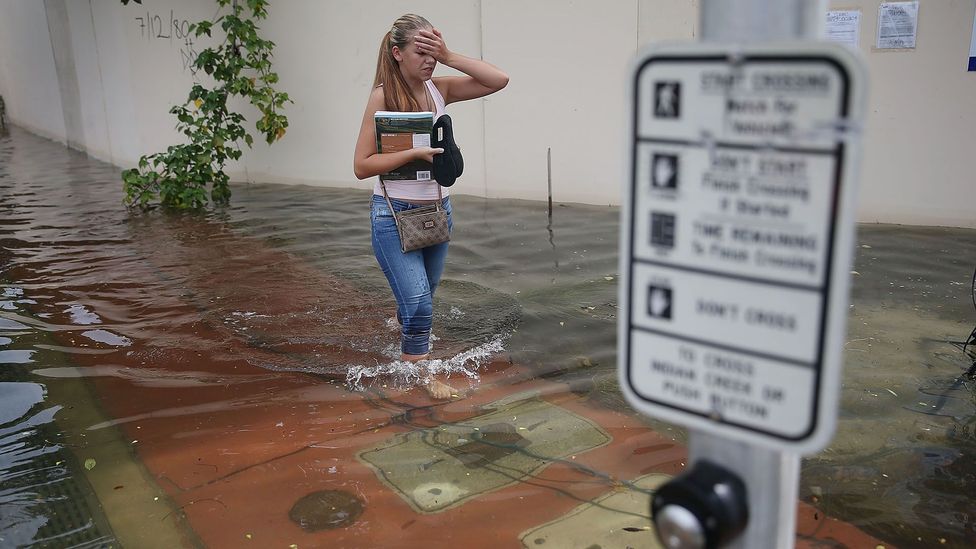
Floods and rising body of water levels are becoming more common in littoral regions like Florida every bit populations grapple with the furnishings of climate change (Credit: Getty Images)
LOST CITIES
You don't need to look very hard in a place like Miami to meet how cities are changing in the 21st Century – rising body of water levels are gradually making some of them disappear. Fuelled by climate change, not merely are floods becoming more mutual in the streets, just the changing weather patterns take likewise influenced edifice design. Aside from more seawalls, the city is requiring all new buildings be congenital with their beginning flooring built higher. But that'south all a sticking plaster – if current trends continue, we may accept to come to terms with losing whole swathes of cities, islands and low-lying regions such equally Bangladesh. The economic impact to regions volition exist profound, and climate refugees could get the norm.
Pressure level is already growing on cities, as urban populations grow. If climatic change forces mass migration, then existing infrastructure, services and economies may be stretched to breaking point.
THE Development OF SOCIAL MEDIA
Social media has complicated the fashion we communicate for the meliorate part of a decade. And information technology'due south not going anywhere anytime before long, given that most people get their news from it now. That's before nosotros even go into the mess of online harassment, equally well. What might social media look like in 30 years, and past that time, what are some threats it might pose?
A earth with no privacy, for one. That'south one problem we're already seeing. And besides weathering abroad our sense of and desire for anonymity and privacy, social media brings with it the many problems of cyberbullying likewise. Many charities and non-profit organisations across the world have mobilised in the fight against cyberspace trolls, but it's an open question about whether police force enforcement agencies and the social media companies can fix it or whether it volition get worse.
Then there'south besides the problem of our data diet to consider: if the condition quo of ubiquitous imitation news remains, how volition that shape how people run into the world? If individuals spend months, years, fifty-fifty decades of their life exposed but to unreliable news sources, information technology does not diviner well for civilised society and fence.
That said, given how fast social media has arrived in the world, an optimist may propose that those problems could presently exist resolved. In 30 years' fourth dimension we may be dealing with social media issues that nosotros've not even considered yet. After all, Facebook is only 13 years old.
NEW GEOPOLITICAL TENSIONS
The by year has seen a complete upset of our geopolitics' fragile balance. That could brand the global stability of the next couple of decades a complete question mark.
North Korean missile launches. Thousands of refugees crossing borders to flee turmoil. Hackers meddling in other nations' elections. Ascension nationalist sentiment worldwide. Headlines in 2016 (and and so far, 2017) have been dominated past never-catastrophe political drama that'southward been fuelling a 'geopolitical minefield' and an 'unprecedented geopolitical shift' – whether it's managing unpredictable North korea, the plight of Syrian refugees, or U.k.'south transition from the European Marriage. Throw in widespread hacking, nuclear missiles and other unsafe engineering, and information technology's easy to come across why maintaining bones diplomacy becomes vital.
Condom CAR TRAVEL
Despite all the rapid urbanisation and talk of bullet trains and fantastical technology similar the Hyperloop coming to the fore, the auto isn't going anywhere – and in fact, in the next couple decades, there will be even more of them on the road.
Driverless car technology is swiftly rolling out, with major tech companies and automakers aggressively seeking to debut man-free vehicles in coming years. Merely in addition, the sheer number of cars – self-driving or not – is going to skyrocket, studies testify. In countries similar Communist china that are seeing a growing center course, the environmental and infrastructural needs that an increasingly road-faring population demands is going to be a yard challenge. How do nosotros ensure safety, fight pollution, and make sure driverless cars aren't a menace on the road?
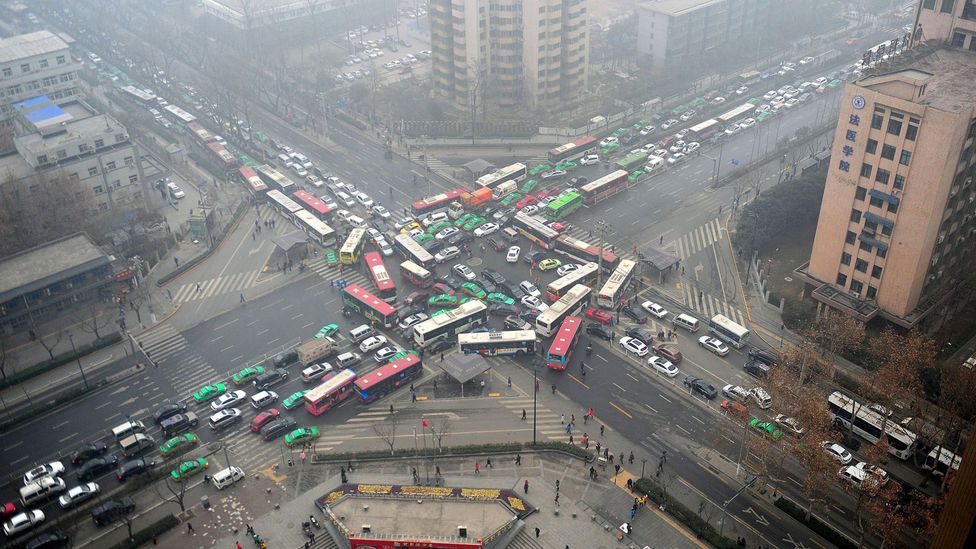
Rapidly industralising countries similar Cathay are seeing equally rapid increases in car ownership(Credit: Getty Images)
DWINDLING Resources
The new tech and devices that characterise the 21st Century all require rare earth metals to brand – an average smartphone has over 60 "ingredients". That'due south putting a strain on the planet's natural resources: in People's republic of china, where 90% of the world's rare earth metals are found, it's estimated that its mines will run out in the adjacent two decades – and skillful substitutes for those materials are hard to come up past.
SETTLING OTHER WORLDS
How will infinite tourism companies make sure their activities are prophylactic? How will we notice ways to send humans to Mars or another planet to live there, equally Stephen Hawking has urged us to figure out? Space travel might seem similar the domain of space agencies and billionaires today, but as information technology becomes more than accessible to everybody else, a whole host of new challenges will emerge. Outer space is increasingly looking less similar the final frontier and more than like our backyard, and with more coin being shelled out to get humans upward to the inky abyss than ever earlier, the logistics, safety and diplomacy behind the challenge all demand serious consideration.
BOOSTED BRAINPOWER
Information technology'south already mutual to apply drugs to boost brainpower (whether it'southward coffee, or something stronger, like modafinil), and near of the developed earth now relies on their smartphones as an 'externalised' memory – but let's extrapolate that out a few decades. Imagine targeted pharmaceuticals that make us call back faster than currently possible, and technological implants that assist us concentrate across normal human ability for hours or days, for example – these advances are already well underway in laboratories around the earth. The question information technology raises is: what happens to those that cannot beget such enhancements? Could information technology widen inequality, and permit the rich to get richer? Then at that place's likewise the legal and upstanding problems: it'due south acceptable to drink a coffee earlier you sit down an exam, but is it ok to use an implant or a smart drug? The challenges posed by intelligence enhancement are only just emerging.
AI'S Dominance IN OUR LIVES
Futurist Ray Kurzweil has made a host of predictions – some inspirational, others downright alarming. 1 of them is the sci-fi-sounding notion that suggests artificial intelligence will ane day go more powerful than human intelligence and improve itself at an exponential rate, otherwise known as 'the singularity'.
It'south far from the majority view, simply few would deny that AI is but going to become more than powerful. So, like in the case of factor editing, the tech and AI community will need to consider the ethical and societal implications of their work as AI comes to shape more realms of our life, from healthcare to financial markets.
As for end-of-the-world extinction scenarios, it's frankly not probable – but that shouldn't obscure the fact that AI is poised to modify how we live and work in profound ways. Information technology is too non impossible that specific AIs could malfunction or run out of their creators' control, leading to very man disasters, where lives are lost or millions of dollars are wiped out.
--
That'south just a taster of what nosotros may confront in 2050. What challenges exercise yous recall are in store for the human being race? Allow us know onFacebook, or Twitter.
+ Read more from our Grand Challenges series:
Is the 'end of modern medicine' near?
Are we running out of country?
How automation will touch on y'all
Garry Kasparov: The upsides of AI
How slow net affects income
Why 'hydro-politics' volition shape the 21st Century
50 grand challenges for the 21st Century
In that location's a problem with the way we define inequality
Bryan Lufkin is the editor of Future Now for BBC Future. Follow him on Twitter at @bryan_lufkin.
Source: https://www.bbc.com/future/article/20170713-what-will-the-challenges-of-2050-be

Post a Comment for "Not Encounter Again in the Future"