The Fab Four Palace of Fine Arts Theatre March 3
 | |
 The lagoon s of the Museum of Science and Industry | |
 | |
| Established | 1933 |
|---|---|
| Location | 5700 South Lake Shore Drive (at East 57th Street), Chicago, Illinois, U.S., 60637 |
| Type | Science and applied science museum |
| Visitors | ane.five 1000000 (2016)[ane] |
| Public transit access | CTA Bus routes: Routes half dozen and 28 (to 56th Street and Hyde Park Boulevard) Route 10 (to Museum of Science and Industry) Road 55 (to Museum of Science and Industry) Metra Train: 55th–56th-57th Street Station (between Stony Isle and Lake Park Avenues) |
| Website | www |
| Chicago Landmark | |
| Designated | November 1, 1995 |
The Museum of Scientific discipline and Manufacture (MSI) is a science museum located in Chicago, Illinois, in Jackson Park, in the Hyde Park neighborhood between Lake Michigan and The University of Chicago. It is housed in the old Palace of Fine Arts from the 1893 World's Columbian Exposition. Initially endowed by Julius Rosenwald, the Sears, Roebuck and Company president and philanthropist, information technology was supported by the Commercial Club of Chicago and opened in 1933 during the Century of Progress Exposition.
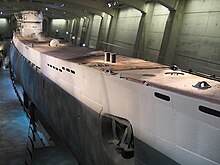
Amongst the museum's exhibits are a full-size replica coal mine, German submarineU-505 captured during Globe War 2, a iii,500-square-foot (330 thousandtwo) model railroad, the control module of Apollo 8, and the first diesel-powered streamlined stainless-steel passenger train (Pioneer Zephyr).
Chevy Humphrey became president and CEO of the private, not-profit[2] museum in January 2021.[3]
History [edit]

Palace of Fine Arts floor plan
The Palace of Fine Arts (also known as the Fine Arts Edifice) at the 1893 World's Columbian Exposition was designed by Charles B. Atwood for D. H. Burnham & Co. The Palace of Fine Arts displayed paintings, prints, drawing, sculpture, and metal work from around the globe.[4]

Interior Of Palace Of Fine Arts — Official Views Of The Earth's Columbian Exposition

Unlike the other "White Metropolis" buildings, it was constructed with a brick substructure under its plaster facade.
After the World's Fair, it initially housed the Columbian Museum, which evolved into the Field Museum of Natural History. When the Field Museum moved to a new building near downtown Chicago in 1920, the former site was left vacant.
Art Constitute of Chicago professor Lorado Taft led a public campaign to restore the building and turn it into another art museum, one devoted to sculpture. The Due south Park Commissioners (now function of the Chicago Park District) won approval in a referendum to sell $5 million in bonds to pay for restoration costs, hoping to turn the edifice into a sculpture museum, a technical trade school, and other things. However, subsequently a few years, the building was selected equally the site for a new science museum.
At this fourth dimension, the Commercial Lodge of Chicago was interested in establishing a science museum in Chicago. Julius Rosenwald, the Sears, Roebuck and Company president and philanthropist, energized his fellow club members by pledging to pay $3 million towards the cost of converting the Palace of Fine Arts (Rosenwald eventually contributed more than $5 million to the project). During its conversion into the MSI, the edifice's exterior was re-cast in limestone to retain its 1893 Beaux Arts look. The interior was replaced with a new one in Art Moderne style designed by Alfred P. Shaw.
Rosenwald established the museum arrangement in 1926 simply declined to take his name on the edifice. For the beginning few years, the museum was often called the Rosenwald Industrial Museum. In 1928, the name of the museum was officially inverse to the Museum of Scientific discipline and Industry. Rosenwald's vision was to create a museum in the style of the Deutsches Museum in Munich, which he had visited in 1911 while in Germany with his family.
Sewell Avery, another man of affairs, had supported the museum inside the Commercial Club and was selected as its showtime president of the board of directors. The museum conducted a nationwide search for the outset director. MSI'due south Board of Directors selected Waldemar Kaempffert, then the science editor of The New York Times, because he shared Rosenwald's vision.
He assembled the museum'due south curatorial staff and directed the arrangement and structure of the exhibits. In order to prepare the museum, Kaempffert and his staff visited the Deutsches Museum in Munich, the Science Museum in Kensington, and the Technical Museum in Vienna, all of which served as models. Kaempffert was instrumental in developing close ties with the science departments of the Academy of Chicago, which supplied much of the scholarship for the exhibits. Kaempffert resigned in early 1931 amid growing disputes with the second president of the lath of directors; they disagreed over the objectivity and neutrality of the exhibits and Kaempffert's direction of the staff.
The new Museum of Scientific discipline and Manufacture opened to the public in three stages between 1933 and 1940. The showtime opening ceremony took place during the Century of Progress Exposition. Two of the museum'due south presidents, a number of curators and other staff members, and exhibits came to MSI from the Century of Progress effect.
For years, visitors entered the museum through its original main entrance, but that archway became no longer large plenty to handle an increasing volume of visitors. The newer principal archway is a structure discrete from the chief museum building, through which visitors descend into an underground area and re-ascend into the main building, similar to the Louvre Pyramid.
In 1983, due to increased attendance, the museum started construction of its clandestine parking lot, located in three underground levels below the front lawn. Construction of the clandestine parking lot was finished in the 1990s.
For over 55 years, admission to the MSI was free, although some exhibits such as the Coal Mine and U-505 required small fees. General entrance fees were first charged in the early 1990s, with general admission rates increasing from $13 in 2008 to $xviii in 2015.[v] [6] Many "free days"—for Illinois residents merely—are offered throughout the year.[seven]
On October 3, 2019, the museum announced that it intends to modify its proper name to the Kenneth C. Griffin Museum of Science and Industry afterward a donation of $125 million from Chicago billionaire Kenneth C. Griffin. It is the largest single gift in the museum's history,[8] [9] effectively doubling its endowment. However, president and master executive officer David Mosena said the formal name change could take some fourth dimension, due to the complexity of the process. He as well said function of the gift will go into funding "a state-of-the-fine art digital gallery and performance space that will be the only experience of its kind in North America."[10]
Exhibits [edit]



New York Central and Hudson River Railroad No. 999



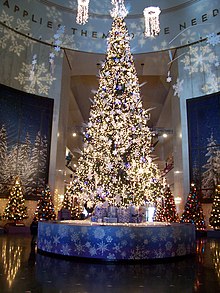
Christmas Effectually the Globe
The museum has over 2,000 exhibits, displayed in 75 major halls. The museum has several major permanent exhibits. Access to several of the exhibits (including the Coal Mine and U-505) requires the payment of an additional fee.[six]
Entry Hall [edit]
The starting time diesel-powered, streamlined stainless-steel train, the Pioneer Zephyr, is on permanent display in the Great Hall, renamed the Entry Hall in 2008. The railroad train was once displayed outdoors, but it was restored and placed in the former Cracking Hall during the construction of the museum'southward hugger-mugger parking lot.
Lower Level [edit]
U-505 [edit]
German submarineU-505 is i of just six High german submarines captured past the Allies during Globe War II,[11] and, since its inflow in 1954, the merely one on display in the Western Hemisphere, also as the merely one in the United States. The U-gunkhole was newly restored outset in 2004 subsequently 50 years of being displayed outdoors, and was then moved indoors as "The New U-505 Feel" on June 5, 2005. Displayed in an underground shed, information technology remains every bit a pop exhibit for visitors, too as a memorial to all the casualties of the Boxing of the Atlantic during Globe War II. Commonly, guided tours of the submarine are offered for an additional fee. As a issue of the COVID-19 pandemic, these tours are currently temporarily unavailable. However, virtual tours are offered for an additional fee. Near the U-505 there is both a Mold-A-Rama machine and a penny flattening device. Both have U-505 designs.
Henry Crown Space Center [edit]
MSI's Henry Crown Space Center includes the Apollo eight spacecraft, which flew the starting time mission beyond low world orbit to the Moon, enabling its crew, Frank Borman, James Lovell and William Anders, to become the first human beings to come across the Globe as a whole, besides as becoming the first to view the Moon up close (as well equally the first to view its far side). Other exhibits include Scott Carpenter'due south Mercury-Atlas 7 spacecraft and a lunar module trainer.
Located in the Henry Crown Space Center is a domed theater, considered to exist the merely domed theater in Chicago. The screen of the theater is made of perforated aluminum, allowing the speakers mounted behind the screen to be heard throughout the theater.
FarmTech [edit]
The "FarmTech" exhibit showcases modern agricultural techniques and how farmers use modernistic technology similar GPS systems to improve work on the farm, and includes a tractor and a combine harvester from John Deere. The showroom also showcases a greenhouse, a mock up of a kitchen showcasing much the foods we eat is soybean, and how we use cows, from free energy to what nosotros drinkable.
Other [edit]
A transportation gallery is located on the museum'south west wing, containing models of "Ships Through the Ages" and several historic racing cars.
"Time to come Free energy Chicago" shows alternative resources, housing developments, and the future of Chicago. The exhibit requires an additional fee.
Some areas in the museum aim for younger children, including the "Swiss Jollyball", the earth'south largest pinball machine built by a British man from Switzerland using nada but salvaged junk; the "Idea Mill", a toddler water table play area; and the "Circus", featuring blithe dioramas of a miniature circus as well as containing a shadow garden and several funhouse mirrors.
Silent-film star and stock-market investor Colleen Moore'south Fairy Castle "doll's business firm" is on brandish.
First Level [edit]
Numbers in Nature: A Mirror Maze [edit]
Numbers in Nature: A Mirror Maze contains an interactive theater and stations to learn about patterns in nature, including the Golden Ratio, spirals, fractal branching, and Voronoi patterns.[12]
It too contains a mirror maze to assist emphasize the geometric patterns that can be utilized.
Transportation Gallery [edit]
The Transportation Zone contains several permanent exhibits.
The Cracking Train Story is a 3,500-square-foot (330 mii) HO-scale model railroad and recounts the story of transportation from Chicago to Seattle.[13]
The museum includes a replica of Stephenson'southward Rocket, which was the get-go steam locomotive to exceed 25 miles per hour.
The 999 Empire Land Express steam locomotive was alleged to be the starting time vehicle to exceed 100 miles per hour (160 km/h) in 1893, although no reliable measurement e'er took place (and such a speed was probable incommunicable).[a] Designed to win the battle of limited trains to the Earth'due south Columbian Exhibition, it was donated to the museum by the New York Central in 1962. The locomotive was located exterior the museum until 1993, when extensive restoration took place and it was moved indoors equally an exhibit in the Transportation Zone.
A replica of the Wright Brothers first airplane, the Wright Flyer, is on display.
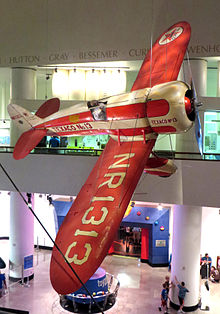
Two World War Ii warplanes are also exhibited. Both were donated past the British regime: a High german Ju 87 R-2/Trop. Stuka divebomber—ane of but ii intact Stukas left in the world—and a British Supermarine Spitfire. Likewise on brandish is the museum's Travel Air Blazon R Mystery Ship, nicknamed "Texaco 13", which set many world records in flight.
"Take Flight" features the first Boeing 727 jet airplane in commercial service, donated by United Airlines, with i wing removed and holes cut on the fuselage to facilitate company access.
Science Storms [edit]
In March 2010, the museum opened "Science Storms" in the Allstate Court, equally a permanent exhibit.[15] This multilevel exhibit features a 40-pes (12 yard) water vapor tornado, tsunami tank, Tesla ringlet, heliostat organization, and a Wimshurst machine built by James Wimshurst in the belatedly 19th century. Also housed are Newton'due south Cradle, the color spectrum, and Foucault pendulum. All artifacts allow guests to explore the physics and chemistry of the natural earth.[16]
Genetics: Decoding Life [edit]
In keeping with Rosenwald's vision, many of the exhibits are interactive. "Genetics: Decoding Life", looks at how genetics touch human and animal development equally well equally containing a chick hatchery composed of an incubator where baby chickens hatch from their eggs and a chick pen for those that take already hatched, likewise as housing genetically modified frogs, mice, and drought resistant plants.
ToyMaker 3000 [edit]
"ToyMaker 3000", is a working associates line which lets visitors gild a toy top and lookout man as information technology is made. The interactive "Fab Lab MSI" is intended as an interactive lab where members can "build anything".
Coal Mine [edit]
The "Coal Mine" re-creates a working deep-shaft, bituminous coal mine inside the museum's Central Pavilion, using original equipment from Old Ben #17, circa 1933. Information technology is ane of the oldest exhibits at the museum. In this unique exhibit, visitors go hole-and-corner and ride a mine train to unlike parts of the mine and learn the basics of its operation. The experience takes around 30 minutes and requires an additional fee.[17]
Yesterday'southward Master Street" [edit]
"Yesterday's Master Street" is a mock-upwardly of a Chicago street from the early 20th century, complete with a cobblestone roadway, one-time-fashioned light fixtures, fire hydrants, and several shops, including the precursors to several Chicago-based businesses. Included are:
- The Berghoff restaurant
- Chicago Post Office
- Republic Edison
- Finnigan'due south Ice Cream Parlor and Photo Studio
- Gossard Corset Shop
- Jewel Tea Company grocery
- Jenner and Block Police force office
- Lytton's Clothing Shop
- Dr. John B. Tater'due south office
- The Nickelodeon Movie house
- Chas. A. Stevens & Co.
- Walgreens Drug Visitor
Unlike the other shops, Finnigan's Water ice Cream Parlor and The Nickelodeon Movie theater can be entered and are functional. Finnigan's serves an assortment of ice cream and The Movie theater plays short silent films throughout the day.
Other [edit]
In spring 2013, the "Art of the Bicycle" exhibit opened, showcasing the history of the bike and how modernistic bikes continue to evolve.
"Reusable Urban center" focuses on recycling and other methods that could cut down harmful pollution and especially climate change and the Regenstein Hall of Science, containing a giant periodic table of the elements. Other main level exhibits include: "Fast Forward", which features some aspects of how technology will alter in the hereafter; "World Revealed", featuring a "Science on a Sphere" holographic earth; and a "Whispering Gallery".
2d Level [edit]
Y'all! The Feel [edit]
The museum is as well known for unique and quirky permanent exhibits, such equally a walk-through model of the man middle, which was removed in 2009[18] for the construction of "YOU! the Experience",[xix] which replaced it with a thirteen-foot-tall (4.0 grand), interactive, 3D heart.[20] Likewise well known are the "Body Slices" (two cadavers exhibited in one⁄two -inch-thick (13 mm) slices) in the exhibit.

Other [edit]
Several US Navy warship models are too on brandish in the museum, and flight simulators including of the new F-35 Lightning Two are featured.
Former Exhibits [edit]
An F-104 Starfighter on loan to MSI from the U.s. Air Forcefulness since 1978 was sent to the Mid-America Air Museum in Liberal, Kansas, in 1993. In March 1995, Santa Fe Steam Locomotive 2903 was moved from exterior the museum to the Illinois Railway Museum. "Telefun Town", a hall dedicated to the wonders of phone communication, sponsored past the company so known as "The Bell Telephone Company", no longer exists.
Exhibitions [edit]
In addition to its three floors of standing exhibits, the museum hosts temporary and traveling exhibitions. Exhibitions last for five months or less and unremarkably require a dissever paid admission fee.[6] Exhibitions at MSI have included Titanic: The Exhibition,[21] which was the largest display of relics from the wreck of RMS Titanic; Gunther von Hagens' Body Worlds, a view into the human body through apply of plastinated human specimens; Game On,[22] which featured the history and civilization of video games; Leonardo da Vinci: Man, Inventor, Genius;[23] CSI: The Experience; Robots Like Usa;[24] City of the Future;[25] Star Wars: Where Science Meets Imagination; The Glass Experience; Harry Potter: The Exhibition;[26] Robot Revolution, which was sponsored by Google and featured numerous easily-on demonstrations and advice from experts for prospective future robot scientists and engineers;[27] and four installments of Smart Habitation: Green + Wired, featuring the work of green architect Michelle Kaufmann.[28] The Science Behind Pixar showroom opened May 24, 2018.[29] The Wired to Wear exhibit opened on March 21, 2019.[30] [31] [32] The touring exhibit Marvel: Universe of Super Heroes officially opened to the public on March vii, 2021.[33]
Yearly, from late November to early January, the museum hosts its Christmas Around the World and Holidays of Light exhibit, featuring Christmas trees from different cultures from around the world. Started in 1942 with just one tree to award soldiers fighting in Earth War Ii, the tradition spawned into more than 50 trees.

Interior panorama, viewed from a central hall
See too [edit]
- Architecture of Chicago
- List of museums and cultural institutions in Chicago
References [edit]
Explanatory notes [edit]
- ^ Another contender is GWR 3700 Grade 3440 City of Truro. The claim of the Empire State Express has little supporting evidence; dissimilar City of Truro, there are no timings showing the acceleration up to 100 mph. Some contemporary American technical journals doubted that such a high speed had been attained: "Many are tending to receive with uncertainty the argument that on nine May the locomotive No. 999 of the New York Central railroad ran at the speed of 100 miles an hour, or that on a subsequent date she ran a unmarried mile in 32 seconds".[14]
Citations [edit]
- ^ "TEA-AECOM 2016 Theme Index and Museum Alphabetize: The Global Attractions Attendance Report" (PDF). Themed Entertainment Clan. pp. 68–73. Retrieved March 23, 2018.
- ^ "Media FAQs".
- ^ "MSI Welcomes Chevy Humphrey". Retrieved February 1, 2021.
- ^ Department of Publicity and Promotion (1893). Globe's Columbian Exposition, 1893: official catalogue. Part X. Section Thou. Fine arts. Chicago: W.B. Conkey.
- ^ "Siemens Makes Donation to the Museum of Science and Industry, Chicago". Siemens Corporation. August thirteen, 2008. Retrieved December 27, 2014.
- ^ a b c "Tickets". Museum of Science and Manufacture. 2017. Retrieved April 27, 2017.
- ^ "Ticket Prices: 2017 Illinois Free Day Schedule". Museum of Science and Industry. 2017. Retrieved Apr 27, 2017.
- ^ Dudek, Mitch (October 3, 2019). "Museum of Science and Industry changing name later on $125M gift from Ken Griffin". Chicago Lord's day-Times.
- ^ "Historic Gift". www.msichicago.org.
- ^ Johnson, Steve (October 3, 2019). "The Museum of Science and Industry is getting a new proper name subsequently Chicago billionaire Ken Griffin donates $125 1000000". Chicago Tribune . Retrieved October 3, 2019.
- ^ "Defeating the Sharks: The Capture of U-505". Naval History and Heritage Command. Retrieved November 16, 2020.
- ^ "Explore the Patterns". www.msichicago.org . Retrieved Apr 27, 2020.
- ^ Swanson, Carl (June 2003). "Chicago masterpiece: Museum of Science and Industry's original layout delighted generations". Model Railroader . Retrieved September 22, 2019.
- ^ Allen, Leicester (1893). "Mechanics". Engineering Magazine. 5: 530. Retrieved April 12, 2015.
- ^ "Science Storms". Museum of Science and Manufacture. Retrieved December 27, 2014.
- ^ "Scientific discipline Storms News". Museum of Scientific discipline and Industry. Archived from the original on May 27, 2012. Retrieved May 23, 2012.
- ^ "Coal Mine". Museum of Science and Manufacture. Retrieved December 27, 2014.
- ^ Mullen, William (Baronial 26, 2009). "Museum of Scientific discipline and Industry Gets a New Heart Brandish". Chicago Tribune . Retrieved May 17, 2013.
- ^ "Yous! The Experience". Museum of Science and Industry. Retrieved December 27, 2014.
- ^ "Your Heart". Museum of Science and Manufacture. Retrieved May 23, 2012.
- ^ "Titanic: The Exhibition". Museum of Science and Manufacture. Archived from the original on Feb iii, 2003. Retrieved December 27, 2014.
- ^ "Archived Exhibits". Museum of Scientific discipline and Industry. Archived from the original on April 15, 2013. Retrieved December 27, 2014.
- ^ "Leonardo da Vinci: Man – Inventor – Genius". Museum of Science and Industry. Archived from the original on September 25, 2006. Retrieved December 27, 2014.
- ^ "Robots Like The states". Museum of Science and Manufacture. 2006. Archived from the original on October 16, 2007. Retrieved December 27, 2014.
- ^ "The City of the Futurity: A Blueprint and Engineering Challenge". The History Channel. Archived from the original on July 19, 2007. Retrieved December 27, 2014.
- ^ "Harry Potter: The Exhibition". Museum of Scientific discipline and Industry. 2009. Archived from the original on December 25, 2014. Retrieved December 27, 2014.
- ^ "They, robots: 'Revolution' opens at the MSI". Chicago Tribune . Retrieved June 17, 2015.
- ^ "Smart Home: Greenish + Wired 2012". Museum of Science and Manufacture. Retrieved December 27, 2014.
- ^ "Exhibit / The Science Behind Pixar". msichicago.org. Museum of Science and Industry, Chicago. Retrieved Apr 11, 2018.
- ^ "Wired to Wear". Museum of Science and Industry, Chicago . Retrieved April 1, 2019.
- ^ amandacosco (March 21, 2019). "Museum of Scientific discipline and Industry in Chicago Launches Wired to Wear Featuring Wearables from 360Fashion Network". Electric Runway . Retrieved March 31, 2019.
- ^ Kapfunde, Muchaneta (March 27, 2019). "Wired to Article of clothing Exhibition: The Future of Wearable Engineering science Comes To Chicago". FashNerd . Retrieved March 31, 2019.
- ^ "Curiosity: Universe of Super Heroes". Museum of Science and Manufacture, Chicago . Retrieved February 1, 2021.
Further reading [edit]
- Kogan, Herman. A Continuing Marvel: The Story of the Museum of Science and Industry. 1st ed. Garden City, N.Y., Doubleday, 1973.
- Pridmore, Jay. Inventive Genius: The History of the Museum of Scientific discipline and Industry, Chicago. Chicago, Museum of Science and Manufacture, 1996.
- Pridmore, Jay. Museum of Science and Industry, Chicago. New York, Harry North. Abrams, 1997.
External links [edit]
- Museum website
- Commercials and news clips at The Museum of Archetype Chicago Idiot box
- Loftier-resolution 360° Panoramas and Images at Columbia University
Coordinates: 41°47′26″Due north 87°34′58″Westward / 41.79056°N 87.58278°W / 41.79056; -87.58278
Source: https://en.wikipedia.org/wiki/Museum_of_Science_and_Industry_(Chicago)

Post a Comment for "The Fab Four Palace of Fine Arts Theatre March 3"